
A Brief History of Warwick
Warwick offers to
visitors today the opportunity of exploring not only the architectural
gems of our medieval history but also those of our more recent past and
the modern vibrant life of the county town of Warwickshire.
|
|
|
The town of Warwick was founded on the banks of the
River Avon in 914 AD by Ethelfleda, sister of Edward the Elder, as a
defence against the Danish invaders, on a site overlooking earlier
riverside settlements. It is built on a small hill which controlled not
only the river valley but also the river crossing on the road to London
and the roads to Stratford, Coventry and the salt way to Droitwich. The
Anglo-Saxon town was surrounded partly by a wall and partly by a ditch.
The medieval core of the town was prevented from
expansion by the open spaces that surround it: the Common and Racecourse,
the grounds of the Priory, St Nicholas Meadow, the River Avon, and later,
Warwick Castle. Within a relatively small area there are many buildings of
historic interest, of which the Castle is the most important.
This is one of the most dramatic and complete medieval
castles in the country. It has been inhabited continuously since the
Middle Ages, and was the home of the Earls of Warwick until recently.
|
|
|
| |
Many of the central streets of the town were destroyed
by the Great Fire of 1694. The buildings which were burnt, and many which
were not, were re-built in the handsome style of the late 17th and early
18th centuries. St Mary's Church, which dominates the surrounding
countryside, had a new nave and tower at the same time.
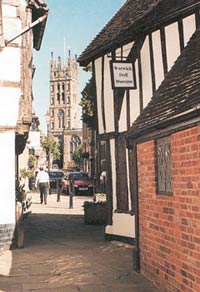
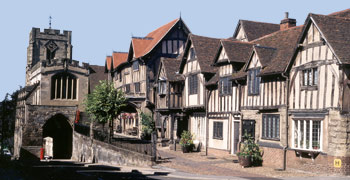
Several important medieval buildings survived the fire
and can be seen to this day, notably the town's medieval Guildhall, now
the Lord Leycester Hospital, as well as a group of timber - framed
buildings around Oken's House.
|
|
Warwick and its historic buildings have featured in
the BBC TV's drama series 'Dangerfield', 'Pride and Prejudice',
'Tom Jones' and Granada Television's 'Moll Flanders'.
|
|
















 History of Warwick