A Brief History of Warwick
Warwick offers to
visitors today the opportunity of exploring not only the architectural
gems of our medieval history but also those of our more recent past and
the modern vibrant life of the county town of Warwickshire.
|
|
|
The town of Warwick was founded on the banks of the
River Avon in 914 AD by Ethelfleda, sister of Edward the Elder, as a
defence against the Danish invaders, on a site overlooking earlier
riverside settlements. It is built on a small hill which controlled not
only the river valley but also the river crossing on the road to London
and the roads to Stratford, Coventry and the salt way to Droitwich. The
Anglo-Saxon town was surrounded partly by a wall and partly by a ditch.
The medieval core of the town was prevented from
expansion by the open spaces that surround it: the Common and Racecourse,
the grounds of the Priory, St Nicholas Meadow, the River Avon, and later,
Warwick Castle. Within a relatively small area there are many buildings of
historic interest, of which the Castle is the most important.
This is one of the most dramatic and complete medieval
castles in the country. It has been inhabited continuously since the
Middle Ages, and was the home of the Earls of Warwick until recently.
|
|
|
| |
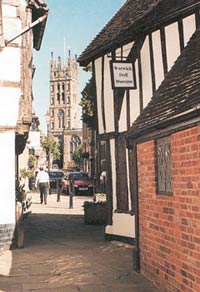
Many of the central streets of the town were destroyed
by the Great Fire of 1694. The buildings which were burnt, and many which
were not, were re-built in the handsome style of the late 17th and early
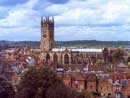
18th centuries. St Mary's Church, which dominates the surrounding
countryside, had a new nave and tower at the same time.
Several important medieval buildings survived the fire
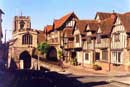
and can be seen to this day, notably the town's medieval Guildhall, now
the Lord Leycester Hospital, as well as a group of timber - framed
buildings around Oken's House.
|
|
Warwick and its historic buildings have featured in
the BBC TV's drama series 'Dangerfield', 'Pride and Prejudice',
'Tom Jones' and Granada Television's 'Moll Flanders'.
|
|
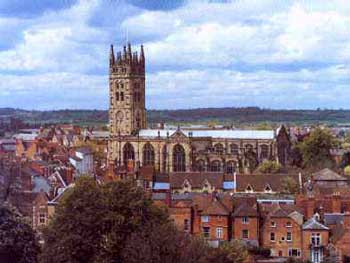
Collegiate Church of St Mary
Old Square
Tel: +44 (0)1926 403940
|
|
|
|
|
|
|
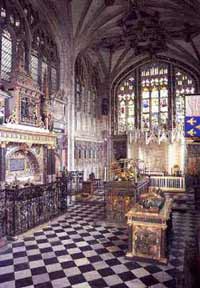
Famous for its Beauchamp Chapel, Medieval/ Tudor tombs and tower. Brass rubbings available.
OPEN ALL YEAR
Daily Summer 10.00 - 17.40, Winter 10.00 - 16.10
CHURCH ADMISSION FREE (Donation welcome)
Tower open all year (Weather Permitting)
TOWER ADMISSION CHARGE
Visit the official St Mary's Church web site - click here.
St Mary's boasts four choirs. For further details, please click here. |
|
 |
|
Hill Close Gardens
Bread and Meat Close
Warwick
CV34 6HF
Tel: 01926 493339
E-mail: CentreManager@hcgt.org.uk
Website: www.hillclosegardens.com
|

|
|
|
This delightful network of individual gardens, separated by high hedges, has recently been restored using Heritage Lottery funding. Delightful summerhouses, gnarled old fruit trees and heritage flowers and vegetables welcome the visitor to this tranquil spot. Buy plants and historic varieties of fruit and vegetables in season. Enjoy tea, coffee and cake in the new "sustainable" visitor centre. View the changing displays. Gifts for sale.
Saturdays and Bank Holidays, 11-5; Fridays and Sundays 2-5. (Easter till last weekend in October)
Admission: adults £3.00; children under 12 free
Access from racecourse car park off Friars Street (2 hours free parking available).
All year round guided tours are available for groups of over 10 people at a charge of £6 a head to include entrance, services of a guide and tea and cake. Also the Centre (capacity 60 people) has a well equipped kitchen and good projection facilities and is available for hire. Further information on both tours and lettings can be obtained from the Centre Manager tel 01926 493339 or email Centremanager@hcgt.org.uk.
|
Lord Leycester Hospital and Master's Garden
High Street
Tel: +44 (0)1926 491422
E-mail: lordleycester@btinternet.com
Website: www.lordleycester.co.uk
|
The historic group of buildings that now comprise the Hospital, is now dominated by the ancient Chantry Chapel of St James, built over the West Gate into Warwick by Thomas Beauchamp, 12th Earl of Warwick, in the latter half of the 14th Century.
The Guild of St George was created under a license issued by King Richard II on 20th April, 1383, and Thomas Beauchamp granted the benefice of the Chantry Chapel to the Guild on its formation. Sometime between 1386 and 1413, the Guild of the Blessed Virgin, based at the Collegiate Church of St Mary, joined the Guild of St George at the West Gate. To accommodate the resident priests and the guilds, reception, meeting and dining halls were built as well as living quarters. They became known as the United Guilds of Warwick.
In 1546, when they were dispersed by King Henry VIII, the United Guilds were able to save their property from seizure through the admirable foresight of their Master, Thomas Oken, who had it transferred to the Burgesses of Warwick.
In 1571, Robert Dudley, Earl of Leycester acquired the buildings and founded, under charter from Queen Elizabeth I, a Hospital for aged or disabled soldiers and their wives. The Charter set up a corporation consisting of the Master in charge of the Hospital and the twelve resident Brethren, which was endowed with estates producing an income of £200 per year. To accommodate them, parts of the buildings, including the Guildhall itself, were divided into primitive quarters. These arrangements remained unchanged until 1950, when the Guildhall was cleared and the number of Brethren temporarily reduced to five.
During this period of nearly 400 years, the adminstration of the Hospital continued under the Charter as originally laid down, to which had been added a set of regulations drawn up by the Earl of Leycester.
In 1956, an Act of Parliament was passed abolishing the Corporation of the Master and Brethren and replacing it by a Board of Governors, who decided to restore the building and modernise the quarters.
Queen Elizabeth, the Queen Mother, opened the Hospital after its restoration, on 3rd November, 1966.
Today, 8 ex-servicemen and their wives live in modernised flats and in return give their services towards the running of the Hospital.
For various reasons over the years, the Hospital's estates have been disposed of, such that it is now a self-supporting charity relying largely on income from visitors.
The Master's Garden
Hidden behind the Master's House lies a tiny, beautiful, tranquil garden. Lovingly restored by a past Master's wife, its delightful planting echoes a former time. The garden is open to visitors from Easter until October.
Unique features include the 12th Century Norman arch, a stone vase reputed to have crowned the 2,00 year old Egyptian 'Nilometer' and a very early pineapple pit. Featured in Country Life, BBC's Gardener's World, Doctor Who and David Dimbleby's 'How we built Britain'.
The Brethren's Kitchen provides morning coffee, light lunches and afternoon tea from Easter until October.
Admission: Adults: £4.90, Children: £3.90, OAP £4.40.
Garden only: £2.00, Children £0.50.
|
|
|
|
Saltisford Canal Trust
The Saltisford
Tel: +44 (0)1926 490006
Website: www.saltisfordcanal.co.uk
|
|
|
| Colourful canal urban fringe park, run by local charity on the Saltisford Arm of the Grand Union Canal. Gardens, picnic sites, day hire canal boats with full handicapped access, canal side shop and information centre, refreshments, day fishing and overnight visitor moorings.
Open daily year round, Shop open 7 days a week March to October, Weekdays November to February.
|
|
St John's Museum
St John's
Tel: +44 (0)1926 412132 or 412021
|
|
|
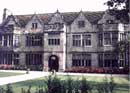
| A charming Jacobean mansion housing period reconstructions of a Victorian kitchen and classroom. Includes dolls and toys, a discovery room for the under 5's and also houses the Royal Warwickshire Regimental Museum. Children most welcome. Landscaped gardens suitable for picnics.
OPEN ALL YEAR (Closed Mondays) - ADMISSION FREE (donations welcome)
Tuesday - Saturday (also Bank Holiday Mondays)
10.00 - 17.00
Sundays (April - September only) 14.30 - 17.00
Events and holiday activities - Phone 01926 412034
|
|
St Nicholas Park
|
|
|
|
Warwick Tea Rooms 01926 492962 (Open all year round)
Includes a new miniature 18 hole golf course instead of crazy golf course, and also add giant chess board, picnic area, remove football courts and change to all weather pitch, after recreation ground remove and replace with Leisure centre including swimming pool, sports hall and fitness suite
|
|
The Mill Garden
Mill Street
Warwick
Tel: 01926 492877
At the bottom of Mill Street is the Mill Garden, famed for the quality of its planting in an unbelievable setting. It was created over a period of sixty years by the late Arthur Measures, who made it a personal expression of his love of plants. On one side are the river and the ruin of the mediaeval bridge, whose roadway once led across where there are now lawns and flowers. In a lucky year, swans nest in its shelter. On the other side, Caesar's Tower looms overhead. The stone walls of the castle give one of the most dramatic backdrops for any garden. Open: April-October daily 9am-6pm, Admission £1.50, accompanied young children free, plant sales. Tel: 01926 492877.
The Queen's Own Hussars Museum
The Lord Leycester Hospital, 60 High Street
Warwick
Tel: +144 (0)1926 492035
E-mail: qohmuseum@qrh.org.uk
Website: www.qohmuseum.org.uk
|
|
|
|
The Cavalry Regiment of the West Midlands – the past to the present
Riding into Battle by Horse and Tank
One of the three Warwick Military Museums.
Normally Open Tues to Sat
Summer 10.00-17.00
Winter 10.00 - 16.00
Tel +144 (0)1926 492035
Within The Lord Leycester Hospital NO FURTHER ADMISSION CHARGE
Covering over 300 years of service of the senior light cavalry regiment of the British Army, the lives of a few individuals have been chosen to bring to life each era. A chronology board relates the regimental and military events to other national and local historical events.
The Museum starts with the raising of the regiment and early service (1685-1742). The wars against the French (1742-1815) include the Battle of Dettingen and the story of Thomas Brown, the Gallant Dragoon. The Napoleonic Wars cases highlight the Peninsular Campaign and Waterloo.
|
|
|
19th Century and Colonial Wars (1815-1914) are illustrated through life-sized tableaux, one being a scene featuring Captain Walter Unett, a local man, and one and one of a stable and a trooper preparing his horse for review. There are displays commemorating the two Indian Mutiny VCs, photographs of 19th century life, and displays of pre-and post-khaki uniforms and equipment. |
|
 |
|
|
The museum has been further redeveloped in 2003/4. The new displays chart the changeover to modern tank warfare during the 1930s, Second World War, and post War highlights including peacekeeping.
|
|
|

|
|
An audio-visual experience shows the part played by the Regiment at great cost in the in the closing stages of the Battle of El Alamein, in the 8th Army under command of General Montgomery of the Warwickshire Regiment. |
|
|
The story into the 21st Century includes a large screen display of a Challenger 2 tank, showing all the crew positions and their tasks.
There are also a Medal Collection, archives for research and enquiries, handling items, family fun activities, and a small shop. |
|
Warwick Castle
Tel: +44 (0)870 442 2000
|
|
|
| Britain's greatest Mediaeval experience at Warwick Castle. From a Mediaeval household in the Kingmaker exhibition to a Victorian 'Royal Weekend Party'. Kingmaker feasts and Highwayman Suppers most Fridays and Saturdays.
|
|
 |
|
|

|
|
OPENING TIMES
Warwick Castle is open all year except Christmas Day. January - March, October - December: 10am - 5pm
April - September: 10am - 6pm
Last admission is half an hour before closing.
We recommend you allow 3-4 hours for your visit to Warwick Castle.
|
|
ADMISSION CHARGES
|
Standard:
|
|
|
|
|
Group Rates (15+) |
Individual |
| Adult |
£12.75 |
£15.95 |
| Senior |
£9.55 |
£11.95 |
| Student |
£9.55 |
£13.95 |
| Child |
£7.95 |
£9.95 |
| Family |
N/A |
£48.00 |
|
Off Peak:
3 September - 7th December 2007 |
|
|
|
|
Group Rates (15+) |
Individual |
| Adult |
£11.15 |
£15.95 |
| Senior |
£7.95 |
£11.95 |
| Student |
£8.60 |
£13.95 |
| Child |
£7.15 |
£9.95 |
| Family |
N/A |
£48.00 |
|
Peak
8 December 2007 - 6 January 2008 |
|
|
|
|
Group Rates (15+) |
Individual |
| Adult |
£14.35 |
£17.95 |
| Senior |
£10.35 |
£13.95 |
| Student |
£10.35 |
£15.95 |
| Child |
£8.75 |
£11.95 |
| Family |
N/A |
£52.00 |
|
A child is aged 4 - 16 years inclusive.
The Family Ticket is for two adults and two children.
Group rates only apply to pre-booked groups of 15+ people.
Warwick Ghosts Alive £2.75 |
Warwickshire Museum - Market Hall
Market Hall
Tel: +44 (0)1926 412500 or 412501
|
|
|
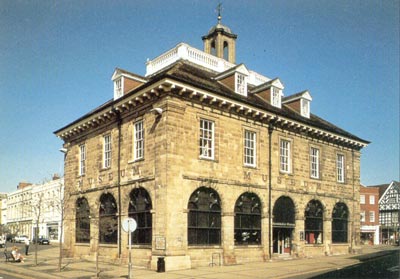
| The Warwickshire Museum contains displays of Archaeology, Geology and Natural History, The Great Fire of Warwick and Sheldon's Tapestry Map.
OPEN ALL YEAR (Closed Mondays)
Tues - Sat 10.00 - 17.00
Sundays (April - September only) 11.30 - 17.00
Bank Holidays: 10.00 - 17.00
ADMISSION FREE (Donations welcome)
|
|
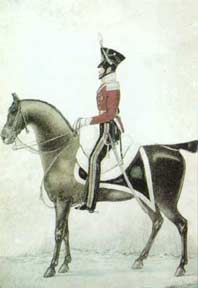
Warwickshire Yeomanry Museum
The Court House, Jury Street
CV34 4EW
Tel: +44 (0)1926 492212
| Uniforms, arms, swords, sabres and selected silver.
OPEN
Easter to October
Saturdays, Sundays and Bank Holiday Mondays.
10.00 - 13.00, 14.00 - 16.00
Other times by appointment.
ADMISSION FREE |
|
|
| The Warwickshire Yeomanry
On the 25th June 1794 the Lord Lieutenant of Warwickshire, the Earl of Warwick had raised by public subscription sufficient money to raise a force of Volunteer Cavalry for the defence of the County in the event of invasion by the French, with whom we were at war. This force comprising Gentlemen and Yeomanry of the County was named the Warwickshire Yeomanry Cavalry and its first commanding officer was the 4th Earl of Aylesford.
The Regiment has had unbroken service since that date and has always comprised men of Warwickshire who have followed normal civilian occupations in peacetime, but have voluntarily trained for war at drill nights, weekends and annual camps. When an internal threat of war has occurred, the Regiment has mobilised to full time service with the forces of the Crown. Over 2000 members of Warwickshire families have served in the Regiment over the past 200 years.
During the 19th Century the Regiment was frequently called out to help maintain law and order in Birmingham, Coventry and Bedworth - particularly during the Chartist Riots from 1837-1840. A volunteer Squadron of the Regiment served with great distinction in the Boer War for a year and a half. The Regiment was mobilised in the Great War and the Second World War and served with great gallantry throughout them both. In the Great War at Gallipoli and at the battles of Katia, Romani, Rafa, El Arish and Huj in Palestine, the latter the scene of the Regiment's famous cavalry charge. In the Second World War the Regiment served in Iraq, Syria and Persia and then with the 8th Army at the Battle of El Alamein where only seven tanks of the Regiment survived, and later the Regiment fought throughout the Italian campaign.
In 1956 the Warwickshire Yeomanry amalgamated with the Worcestershire Yeomanry to form The Queen's Own Warwickshire and Worcestershire Yeomanry. In 1969 the Regiment was reduced by defence cuts to a Cadre and a Signals Squadron. The Cadre expanded in 1971 to a Squadron of the Queen's Own Mercian Yeomanry which in 1992 became The Royal Mercian and Lancastrian Yeomanry. Today our serving successor Squadrons of the Warwickshire Yeomanry are A(QOWWY) Squadron of The Royal Mercian and Lancastrian Yeomanry and 67(QOWWY) Signal Squadron of 37 Signal Regiment.
|
|
|